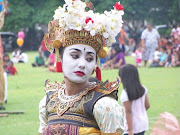
Bali, the Island of Gods, have a lot of special point of interest. Beautiful scenery, gorgeous beach also the Bali’s traditional customs drive people from domestic also foreign come to Bali. They want to see the piece of heaven as well. Bali Hinduism, as a majority religion in this island, approximately 90 percent of total population, influence on all aspect in the Bali’s society. They have various Hinduism ceremonies and holiday to commemorate particular occasion, like full moon,
Galungan, Kuningan, Nyepi, Saraswati, PagerWesi and other rituals in Hinduism.
In March 2009, Bali celebrates 3 (three) important days for Bali Hinduism. There are
Galungan, Nyepi dan Kuningan. In the same time, begin in the third week of March, that’s the campaign period for political parties, as a par of general election schedule. This is the special case for Bali. If in other regional, the campaign period was started in 16th of March, for Bali was begun on 20th March, after the
Galungan celebration on 18th of March.
Galungan means when the dharma is winning, against with
adharma. Galungan occurs every 210 days and lasts for 10 days.
Kuningan is the last day of the holiday. During
Galungan day, gods visit the Earth and leave on
Kuningan.
One week after
Galungan, the other special day for Bali is
Nyepi.
Nyepi is the first calendar of
Saka New Year.
“Nyepi” in terminology, is adopted from
“Sepi”, based on the Indonesian Dictionary, it means
sunyi; lengang (read: quiet; lonely; silent). Then, what does it mean?
Nyepi is time for quiet, time for silent; and then popular with the day of silent. In the Hinduism, they should do ritual which they called with
“Catur Berata”;
Amati Geni (No fire/light);
Amati Karya (No working);
Amati Lelunganan (No traveling);
Amati Lelanguan (Fasting). That’s the principle in Hinduism. In spite of
Nyepi is primarily a Hindu holiday, non-Hindu residents of Bali should observe the day of silence also.
As a consequently of
Catur Berata, it should be observed by Bali’s society in particularly.
All activities will be stopped in 26th of March 2009 as
Nyepi holiday to commemorate the
Catur Berata and meditation. That’s very special day, because Bali will be taking day off, no surfing, no dugem, no party, no swimming, no light, no working, no traveling and no other activities like that.
One day before
Nyepi holiday, Bali Hinduism do a unique ritual. This is the popular ritual on this island. It called “
ogoh-ogoh statues”. It builds for
Pangrupukan eve which takes place on the
Nyepi Day. Ogoh-ogoh statues normally have form of mythological beings, mostly demons or monsters, but now ogoh-ogoh statues have various forms, like celebrities, boxer or other popular people. The main purpose of the making of
Ogoh-ogoh is the purification of the natural environment of any spiritual pollutants emitted from the activities of living beings (especially humans).
Ogoh-ogoh statue is made by the people of
banjar (read: village) around Bali. In
Pangrupukan eve, usually they lift up the
ogoh-ogoh statue, and then go around
banjar. Like a parade, children sing various songs as well. Finally
ogoh-ogoh is burnt to ashes in a cemetery as a symbol of self-purification, before enter the New Year.
This year,
ogoh-ogoh parade got a ban from the local government. It is related on the political parties’ campaign period in the same time. Local government worries that it can make the local security become unstable because of two big activities in Bali;
ogoh-ogoh festival and political parties campaign; will invite lot of people. In the
Pangrupukan eve next year,
ogoh-ogoh parade will be coming back again.
That is the regulation from Bali’s local government. But,
ogoh-ogoh statue still can be found in there. Wednesday, 25th March 2009, on 08.40, Bali’s Local Time, the traffic jam was held in the
Jalan Raya Kuta, Bali. People who passed in
Jalan Raya Kuta were surprised. They can see some young man make an
ogoh-ogoh, and put it in the road. In the afternoon,
ogoh-ogoh statues also can be seen in the several streets in Denpasar, like
Teuku Umar and
Diponegoro Highway. The
ogoh-ogoh parade also can be seen in some banjar in Denpasar as well.
The Value of NyepiCatur Berata in
Nyepi Day has many values for our life. All activities should be stopped. One day without working, light, electricity also. As a tourism destination, Bali is very busy every day. Bali never sleeps, twenty four hour Bali hectic always. Numerous vehicles like motor cycle, bus, and car as well make the road in Bali crowded. Surely, they need fuel every day. Then, all activities can’t be rid of with electricity, included in Bali. People use electricity for the lamp, television, computer, refrigerator etc. The electricity needs the fuel too.
A lot of advantage can be reached from
Nyepi Day.It is time for meditation, contemplation and reflection, what happen in the last year, and what should we do in the next year. Stop the daily activities, can save energy particularly in fuel, electricity also.
Perusahaan Listrik Negara (State Electricity Firm) said that if in
Nyepi Day, it can save energy approximately 3 billion (assumed US$ 1 equal Rp 12.000, 00), equivalent US$ 250.000. This is very fantastic. The spirit of
Nyepi should be spread to the other region, because of the global crisis, particularly in energy crisis. Definitely,
Nyepi in addition saving on the fuel, because all vehicles/ land, water, air transportation as well, should be stopped.
In line with that spirit, the famous program from
WWF called
Earth Hour. On 28th March 2009, this program will invite all people to join for switch off the electricity, precisely on 08.30 pm until 09.30 pm local time. This is a fantastic program also and should be campaigned to other people, in the target for save the energy.
Last but not least, the spirit of
Catur Berata and
Nyepi bring many benefit for our life; reflection, contemplation, saving the energy as well. It possibly will bring our life better.